



Department Establishment:
Anc: 1969-1970
M.Sc., Physics: 2004-2005
M.Phil., Physics: 2014-2015
Vision:
• To stimulate the interest of the students in Physics and lay a strong foundation in the subjects, to motivate them towards research and render them competent and socially committed.
Mission:
• To design a relevant curriculum to suit the growing trends of technology.
• To train the students to apply laboratory skills.
• To develop the potentials of the students for independent thinking and creativity through project work.
• To promote collaborative research culture.
| Name of the Programme | M.Sc., Physics |
| Duration | 2 Years |
| Intake | 25 |
| Eligibility | • For admission to M.Sc. Physics, a candidate must have passed a 3 years’ degree course in Physics (B.Sc. Physics) (under the 10+2+3 pattern) recognized by the university as equivalent there to. • For admission to PG programme, the qualifying examination marks in Part – III (Major, Allied/Ancillary) alone will be taken into consideration. |
SYLLABUS 2026
Programme Learning Outcomes (PLOs)
Programme Learning Outcomes are narrower statements that describe what students are expected to know and be able to do upon the graduation. These relate to the skills, knowledge and behavior that students acquire in their study through the Programmes.
PLO1: Disciplinary Knowledge
Apply the knowledge of Arts, Science and Humanities to address fundamental and complex questions appropriate to their programmes.
PLO2: Critical thinking, Problem solving and Analytical reasoning
Make use of appropriate knowledge and skills to identify, formulate, analyze and solve problems in order to reach substantiated conclusions.
PLO3: Research related skills and scientific reasoning
Critically analyze research processes, products and practices with a view of strategic use of data in their field.
PLO4: Communication skills and Digital literacy
Demonstrate skills in oral and written communication and make use of ICT in various learning ambience.
PLO5: Team work and Leadership quality
Interact productively with people from diverse backgrounds as both leaders/mentors and team members with integrity and professionalism.
PLO6: Multicultural competence with Moral and ethical awareness
Defend the society against gender and environmental issues with moral and ethical awareness.
PLO7: Self-directed and Life-long learning
Formulate their own educational needs in a changing world in ways sufficient to maintain their competence and to allow them to contribute to the advancement of knowledge.
Programme Educational Objectives (PEOs)
PEOs are broad statements that describe the career and professional achievements that the programme is preparing the graduates to achieve within the first few years after graduation. PEOs should be consistent with the mission of the Institution. PEO’s can be measured by a PLO/ PSO - PEO matrix. The PEO’s should evolve through constant feedback from alumnae, students, industry, management etc. It is mandatory that each PEO should be mapped to at least one of the PLOs.
The Graduates will be prepared to
PEO1: become component professional in industry, consultancy, education, research and public administration.
PEO2: excel as Junior Research Fellow, research associates; analyze complex problems and experimental data in Physics imbibed by ethical, moral and social values leading to highly cultured and civilized physicist.
PEO3: become tutors, tech or digital entrepreneur and undertake projects.
Programme Specific Outcomes (PSOs)
Programme Specific Outcomes denote what the students should be able to do in their discipline at the time of graduation. They are programme specific. The PSOs should be mapped to all the specified PEOs.
By the completion of the M.Sc. Physics programme, the learners will be able to
PSO1: acquire knowledge in the areas of Mathematical Physics, Electromagnetism, Classical Mechanics, Statistical Mechanics, Quantum Mechanics, Nuclear and Particle Physics etc.
PSO2: perform general Physics and research oriented experiments with appropriate analysis for proper interpretation of results; to undertake projects and present the research findings.
PSO3: independently carry out research to solve real world problems and present a notable scientific report.
SYLLABUS 2023
Programme Learning Outcomes (PLOs)
Programme Learning Outcomes are narrower statements that describe what students are expected to know and be able to do upon the graduation. These relate to the skills, knowledge and behavior that students acquire in their study through the Programmes.
PLO1: Disciplinary Knowledge
Apply the knowledge of Arts, Science and Humanities to address fundamental and complex questions appropriate to their programmes.
PLO2: Critical thinking, Problem solving and Analytical reasoning
Make use of appropriate knowledge and skills to identify, formulate, analyze and solve problems in order to reach substantiated conclusions.
PLO3: Research related skills and scientific reasoning
Critically analyze research processes, products and practices with a view of strategic use of data in their field.
PLO4: Communication skills and Digital literacy
Demonstrate skills in oral and written communication and make use of ICT in various learning ambience.
PLO5: Team work and Leadership quality
Interact productively with people from diverse backgrounds as both leaders/mentors and team members with integrity and professionalism.
PLO6: Multicultural competence with Moral and ethical awareness
Defend the society against gender and environmental issues with moral and ethical awareness.
PLO7: Self-directed and Life-long learning
Formulate their own educational needs in a changing world in ways sufficient to maintain their competence and to allow them to contribute to the advancement of knowledge.
Programme Educational Objectives (PEOs)
PEOs are broad statements that describe the career and professional achievements that the programme is preparing the graduates to achieve within the first few years after graduation. PEOs should be consistent with the mission of the Institution. PEO’s can be measured by a PLO/ PSO - PEO matrix. The PEO’s should evolve through constant feedback from alumnae, students, industry, management etc. It is mandatory that each PEO should be mapped to at least one of the PLOs.
The Graduates will be prepared to
PEO1: become component professional in industry, consultancy, education, research and public administration.
PEO2: excel as Junior Research Fellow, research associates; analyze complex problems and experimental data in Physics imbibed by ethical, moral and social values leading to highly cultured and civilized physicist.
PEO3: become tutors, tech or digital entrepreneur and undertake projects.
Programme Specific Outcomes (PSOs)
Programme Specific Outcomes denote what the students should be able to do in their discipline at the time of graduation. They are programme specific. The PSOs should be mapped to all the specified PEOs.
By the completion of the M.Sc. Physics programme, the learners will be able to
PSO1: acquire knowledge in the areas of Mathematical Physics, Electromagnetism, Classical Mechanics, Statistical Mechanics, Quantum Mechanics, Nuclear and Particle Physics etc.
PSO2: perform general Physics and research oriented experiments with appropriate analysis for proper interpretation of results; to undertake projects and present the research findings.
PSO3: independently carry out research to solve real world problems and present a notable scientific report.

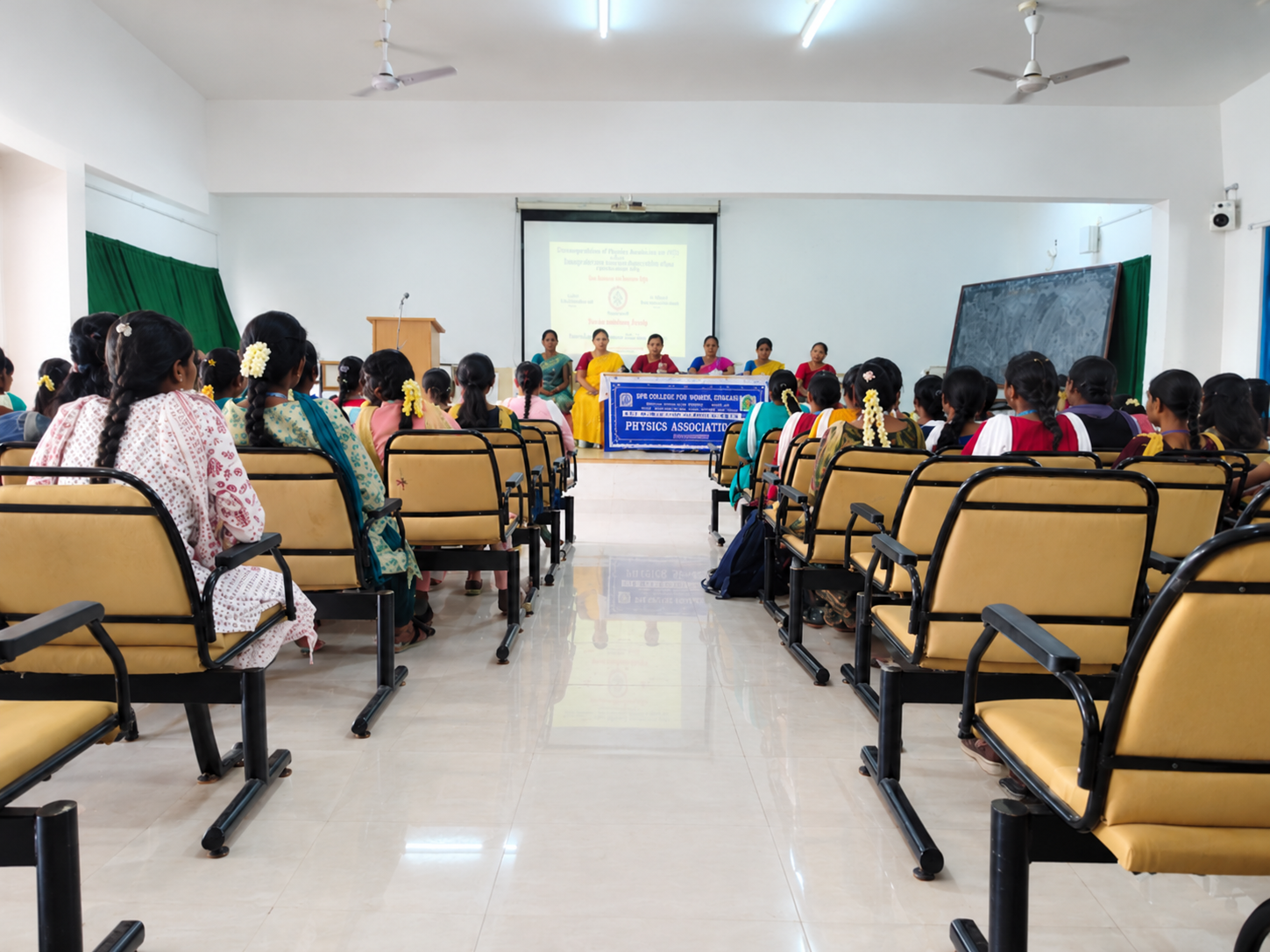
The Inauguration of the Physics Association (PG) was held with Dr. S. Sivadevi, Former Associate Professor and Head, The SFR College for Women, Sivakasi, as the Resource Person. She delivered a lecture on “Building Bricks.”
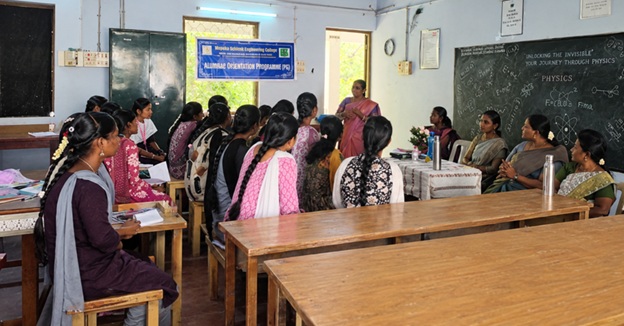
A Guest Lecture on “Unlocking the Invisible: Your Journey Through Physics” was organized with Ms. M. Kaviya, Research Scholar and alumna of the 2019–2021 batch, Department of Physics, Mepco Schlenk Engineering College, Sivakasi, as the Resource Person.